


Private Training & Educational Institution Bond
School / College Surety Bonds for canada
Private training schools, career colleges, and educational institutions across Canada are often required to post a Private Training & Educational Institution Bond (also commonly referred to as an educational institution bond or school bond) as part of their licensing or registration process.
This bond is a form of financial security designed to protect students and regulators in the event that a private institution fails to deliver prepaid education services, closes unexpectedly, or does not meet its regulatory obligations. While the purpose of the bond is consistent nationwide, the exact terminology, bond wording, and requirements vary by province.
Bond Connect helps private training and educational institutions across Canada determine whether they can leverage a bond, the correct bond amount, and the appropriate wording based on the applicable jurisdiction.
What is a Private Training & Educational Institution Bond?
A Private Training & Educational Institution Bond is a surety bond required by provincial regulators to ensure that private educational providers operate responsibly and can meet their obligations to students.
If an institution collects tuition in advance and later fails to provide the contracted education or training, the bond provides a mechanism for student reimbursement or financial protection. The bond does not protect the institution itself, it exists to protect students and the public.
This is commonly enforced in Canada by His Majesty the King in right of [specified province], as represented by the Minister of Post-Secondary Education and Skills Training.
This bond or an alternate form of security is typically required for:
Private career colleges
Vocational and skills training schools
Technical and trade programs
Language schools
Healthcare, flight, and professional training programs
Why do Regulators require Private Training Institution Bonds?
Provincial governments require financial security from private educational institutions to reduce the risk of student losses when tuition is paid upfront.
Unlike public institutions, private schools operate as businesses, and regulators rely on bonds or other financial safeguards to ensure students are not left unprotected.
A surety bond is often preferred because it:
Provides third-party financial backing
Is issued by a licensed surety guarantor
Can scale as tuition exposure increases
Avoids tying up large amounts of cash
Are School Bonds the same in every Province?
No. While this page refers to a general category of bond, the formal name, regulatory authority, and bond wording differ by province.
In practice, this means that:
The bond may be called something different depending on jurisdiction
The bond amount is calculated using province-specific rules
Regulators may impose additional conditions or approval steps
Bond Connect ensures the bond issued matches the exact requirements of the applicable regulator, rather than relying on generic wording that could be rejected.
Below is an overview of how this bond is treated in key provinces. Each of these jurisdictions has explicit financial security requirements, often satisfied through a surety bond.
British Columbia - Private Training Institutions Bond

In British Columbia, this bond is formally known as the Private Training Institutions Bond and is required by the Private Training Institutions Branch (PTIB).
The bond amount is generally based on:
Unearned or prepaid tuition
Student enrollment levels
Program structure and duration
Institutions must maintain an active bond to remain registered and compliant.
Alberta - Private Vocational Training Surety Bond

Alberta refers to this security as a Private Vocational Training Surety Bond.
Private vocational institutions are required to post a bond as part of their registration under provincial legislation. The bond amount typically reflects:
Expected tuition exposure
Program delivery timelines
Risk profile of the institution
This terminology is unique to Alberta but serves the same student-protection purpose.
Ontario - Private Career College Bond

In Ontario, private educational providers are regulated as Private Career Colleges, and financial security is required as part of the licensing framework.
While the term “bond” is not always used formally, surety bonds are commonly accepted as an approved form of financial security. The requirement may also be referred to as:
Private Career College financial security
Student protection security
Ontario institutions may face additional scrutiny regarding bond amounts and acceptable instruments.
How is the Surety Bond Amount Determined?
Bond amounts are not fixed and are typically calculated based on the institution’s financial exposure, including:
Tuition collected in advance
Enrollment volume
Program length
Regulatory risk factors
In most cases, the required bond amount increases as student tuition exposure increases. Regulators may review and adjust bond amounts periodically.
Bond Connect works directly with institutions to ensure the bond amount aligns with regulatory expectations without being excessive.
We do not determine the amount of security that needs to be posted, this is the role of your provincial regulatory body for education standards.
How much does a Private Training & Educational Institution Bond cost?
The cost of the bond is a percentage of the total bond amount being requested and is influenced by:
The institution’s financial strength
Operating history
Ownership structure
Provincial Bond Wordings
Premiums are paid annually and are typically a significantly lower opportunity cost than posting cash or letters of credit for the full bond amount. A typical rate for an educational bond is in the 1.5% range of the bond value.
Below is an indication of annual pricing to expect based on the bond amount required:
Educational Bond Cost Calculator
Based on standard provincial wordings and a balance sheet supporting approximately 3 times the assets of the bond amount being requested.
Please note, this calculator is based on a $15 / $1,000 bond rate which is a common rate underwriters provide when quoting a surety bond private training institutions. A strong financial position can lower this rate; whereas, a weak financial position can increase the rate or leave the applicant ineligible for bonding.
How long does it take to have a Private Training Institution Bond issued?
In most cases, these Educational Bonds can be arranged quite quickly, once the required information is provided.
For most requests:
A few business days turn-around time is possible for the underwriting process.
No in-person visits or paper submissions are required. All application documents, approvals, and payments can be done electronically.
- Currently, only original paper bond copies are accepted by most regulatory bodies. We courier your bond with next-day delivery. If e-bonds are acceptable in your jurisdiction, this method is preferred.
Including the time it may take you to provided the application and financial details, expect a week or so for bond placement timing.
What does the application process look like for an Education Bond?
The underwriting process for tuition collecting school bonds requires the following documentation to be provided for review:
Most Recent External Accountant Prepared Year-End Financial Statements for the institution applying.
Most Recent External Accountant Prepared Year-End Financial Statements for any affiliated businesses, or businesses with shared-ownership.
A Personal Net Worth Statement for each individual having ownership stake in the institution / any affiliated businesses.
Any communications with your provincial regulator indicating the amount of security required to posted.
Potentially Interim / Internal YTD Financial Statements for the applying institution, including:
- Balance Sheet
- Profit & Loss
- Aged Receivables Listing
- Aged Payables Listing
Our role at Bond Connect is to place your bond with a top underwriter, at a competitive rate and assist in making the process as painless as possible.
$25,000 to $5,000,000+ Bond Capacity
Top Canadian Underwriters
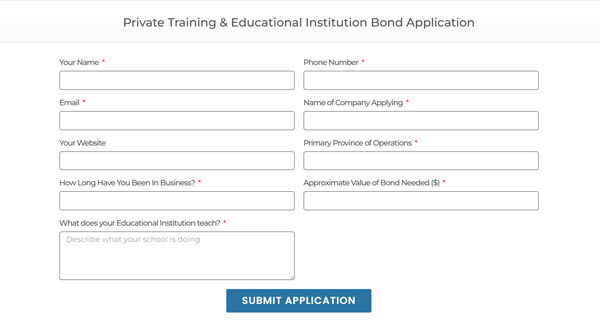
Online Bond Application
Best Rates Nation Wide
Unique Approval Solutions
How It Works



What is the Meaning of Bondable in Canada? The “3 C’s” of Surety
Surety bonds play a crucial role in various industries and sectors across Canada. They provide a level of financial security and guarantee that a business

What Does Artificial Intelligence Mean for the Surety Industry?
An Introduction to OpenAI and ChatGPT OpenAI is a leading artificial intelligence research laboratory that is widely known for its innovative approach to machine learning